Magnesium and Testosterone: The Deficiency Most Men Over 40 Don't Know They Have

Andrei Alencar
Nutritionist · BJJ Black Belt · Alpha40Fit

If you’ve been doing everything right — training, sleeping, eating clean — and your energy and libido still feel flat, magnesium deficiency might be the silent variable you’re missing.
It doesn’t get the attention of zinc or vitamin D. But the research on magnesium and testosterone is among the strongest in men’s health nutrition.
Why Magnesium Deficiency Is So Common After 40
Magnesium is involved in over 300 enzymatic reactions in the human body (NIH Office of Dietary Supplements — Magnesium). It’s critical for muscle contraction, nerve signaling, blood sugar regulation, protein synthesis, and — critically — testosterone production.
And yet, the NHANES data shows that roughly 48% of Americans don’t meet the estimated average requirement for magnesium (NIH Office of Dietary Supplements — Magnesium). That number climbs in men over 40 because of three compounding factors:
1. Absorption declines with age. Intestinal magnesium absorption becomes less efficient as you get older, even with consistent dietary intake.
2. Sweat loss is underestimated. Men who train regularly lose significant magnesium through sweat. A single intense session can deplete 20–30% of your daily requirement through perspiration alone.
3. Modern food is lower in magnesium. Soil depletion over the past 50 years has meaningfully reduced the magnesium content in vegetables, nuts, and grains compared to what previous generations consumed.
You can eat “well” and still be functionally deficient.
The Magnesium-Testosterone Link: What the Research Shows

The relationship between magnesium and testosterone isn’t theoretical. Multiple controlled studies have measured it directly.
A 2011 study published in Biological Trace Element Research followed men over a four-week period. The group that supplemented with magnesium showed significantly higher free and total testosterone compared to controls — and the effect was amplified in men who also exercised regularly (PubMed: Cinar et al., 2011, Biol Trace Elem Res).
The mechanism runs through sex hormone-binding globulin (SHBG).
Most testosterone in the blood is bound to SHBG and therefore unavailable for use — only the “free” fraction is biologically active. Magnesium competes with SHBG for binding sites, which means adequate magnesium levels can increase the percentage of testosterone that’s actually free and functional.
This is a critical distinction. Your total testosterone might look fine on a blood panel. Your free testosterone — what actually reaches your cells — can be significantly lower than it should be.
A second mechanism involves the hypothalamic-pituitary-gonadal (HPG) axis. Magnesium plays a role in gonadotropin-releasing hormone (GnRH) signaling. When magnesium is insufficient, the hormonal cascade that starts in the brain and ends with testosterone production in the testes is disrupted upstream.
Cortisol, Sleep, and Magnesium: The Three-Way Loop

There’s a third pathway that gets almost no attention.
Magnesium regulates the hypothalamic-pituitary-adrenal (HPA) axis — the system that governs cortisol output. Low magnesium → exaggerated cortisol response to stress → chronically elevated cortisol → testosterone suppression.
Cortisol and testosterone are biochemical opponents. They compete for the same precursor molecule (pregnenolone). When your stress system is overactive, it diverts resources away from testosterone production.
And then there’s the sleep connection. Magnesium activates the parasympathetic nervous system and modulates GABA receptors — both critical for entering deep, restorative sleep. Poor sleep further suppresses testosterone. Men who take magnesium before bed consistently report improvements in sleep quality, and those sleep improvements translate downstream into better hormonal output.
This is a three-way compounding effect: low magnesium → high cortisol + poor sleep → lower testosterone. Fix the magnesium, and you address all three simultaneously.
How to Actually Fix It
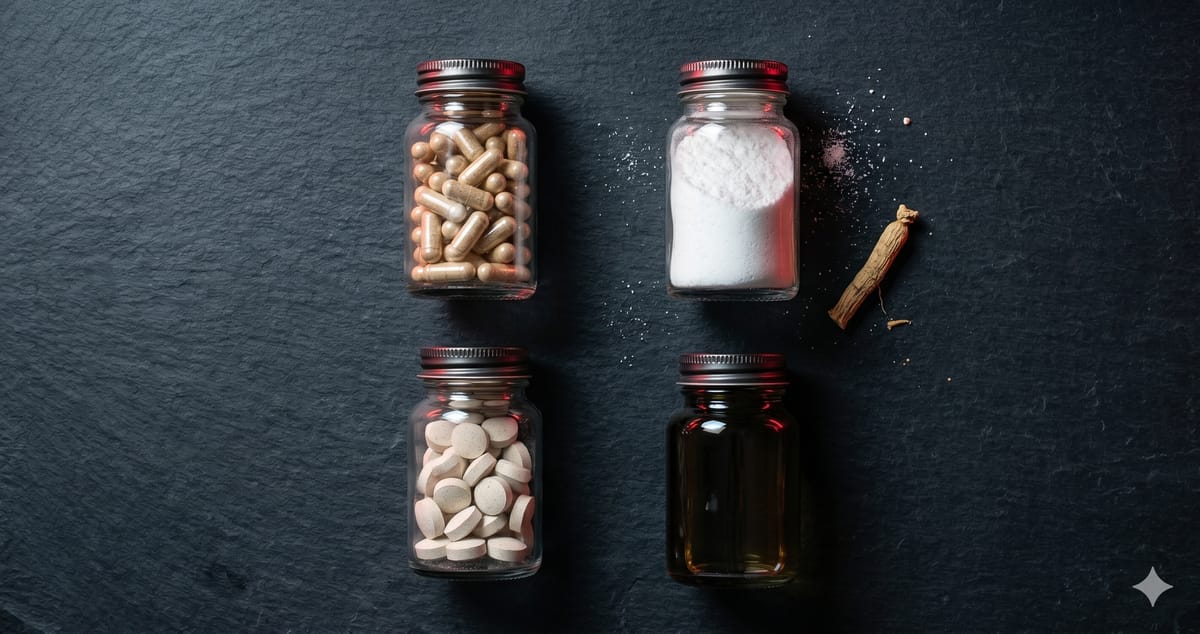
Not all magnesium is the same. This is where most men go wrong.
Magnesium oxide — the most common form in cheap supplements — has roughly 4% bioavailability. You’re absorbing almost nothing.
The forms that actually work:
- Magnesium glycinate: Highest bioavailability, gentle on the stomach, ideal for improving sleep. Best overall choice.
- Magnesium malate: Well-absorbed, malic acid supports mitochondrial energy production. Good for men focused on performance.
- Magnesium citrate: Decent absorption, often used for bowel regularity as well. Works but can cause loose stools at higher doses.
- Magnesium threonate: Specifically studied for neurological function and cognitive performance. Premium option if budget allows.
Avoid magnesium oxide, magnesium carbonate, and most “mineral blends” from discount retailers.
Dosing: The RDA for adult men is 400–420 mg/day. Men who train regularly should target 400–500 mg of elemental magnesium from a high-bioavailability form. Split the dose — half in the morning, half before bed — to improve absorption and maximize the sleep benefit.
Timing: Taking 200–300 mg of magnesium glycinate 30–60 minutes before sleep is the most evidence-backed protocol for both sleep quality and hormonal optimization.
Dietary sources: Dark leafy greens (spinach, Swiss chard), pumpkin seeds, almonds, dark chocolate (85%+), black beans, and avocado are the highest-density food sources. The challenge is that you’d need to eat roughly 200g of spinach, 30g of pumpkin seeds, and a handful of almonds just to hit the RDA. For men with higher needs, diet alone rarely closes the gap.
What to Expect
This isn’t a pharmaceutical. You’re correcting a deficiency, not taking a drug.
Most men who are legitimately deficient notice:
- Better sleep quality within 1–2 weeks — specifically the “waking up rested” feeling that indicates more time in deep sleep
- Improved recovery — less muscle soreness, better muscle relaxation post-training
- Reduced anxiety and better stress tolerance — the cortisol-dampening effect of adequate magnesium is real and noticeable
- Gradual improvement in energy and libido over 4–8 weeks — as the hormonal effects compound
The testosterone effect specifically takes time because you’re working through the HPG axis and SHBG dynamics, not triggering a direct hormonal response.
If you correct the deficiency and feel no change in 8 weeks, magnesium wasn’t your bottleneck — and it’s worth investigating other variables (vitamin D, zinc, thyroid, sleep apnea). And if low energy is your main symptom, remember magnesium is just one cofactor in ATP production — the rest of the machinery (CoQ10, carnitine, PQQ) declines with age too. I broke down the one stack that covers that whole toolkit in my Advanced Mitochondrial Formula review.
Frequently Asked Questions
Does magnesium really raise testosterone?
If you’re deficient, yes. A controlled study found men who supplemented magnesium had significantly higher free and total testosterone than controls, with the effect amplified in those who also exercised (PubMed: Cinar et al., 2011, Biol Trace Elem Res). It works largely by freeing up the bioavailable fraction of testosterone, not by acting as a stimulant on an already-sufficient man.
How do I know if I’m deficient?
Get a red blood cell (RBC) magnesium test, not a standard serum test — serum stays normal even when body stores are low. Roughly half of adults don’t meet the magnesium requirement (NIH Office of Dietary Supplements — Magnesium), and the odds climb with age and hard training.
What’s the best form of magnesium?
Glycinate (best overall, gentle, good for sleep), malate (performance/energy), or citrate (well-absorbed but can loosen stools). Avoid magnesium oxide — it’s about 4% absorbed, so you’re getting almost nothing.
How much should I take, and when?
Active men should target around 400–500 mg of elemental magnesium from a high-bioavailability form, split through the day. Taking 200–300 mg of glycinate 30–60 minutes before bed is the most evidence-backed timing for sleep and hormonal benefit.
How long until I notice anything?
Sleep often improves within 1–2 weeks; the testosterone effect is gradual, building over 4–8 weeks because it works through SHBG and the HPG axis. If nothing changes in eight weeks, magnesium wasn’t your bottleneck.
The Baseline Test
Before spending money on advanced hormone panels, get a red blood cell (RBC) magnesium test — not a standard serum magnesium. Serum magnesium is notoriously unreliable because the body will pull magnesium from bones and tissues to maintain serum levels even when total body stores are low.
RBC magnesium reflects actual intracellular magnesium status. Optimal range is typically 5.2–6.5 mg/dL. If you’re below 5.0, you have your answer.
Many men find that fixing this one deficiency moves the needle more than any other intervention short of medical testosterone therapy. It’s not a miracle. But it’s foundational — and the majority of men over 40 are walking around without it.
The Formula I Point Readers To · Affiliate Link
Rather buy one capsule than four separate bottles?
EndoPeak
Everything this article points to — Tongkat Ali to lower SHBG, plus magnesium, saw palmetto and epimedium — assembled in a single formula. It's the male-performance stack I'm comfortable putting my name next to, because the ingredient choices are defensible (I broke them all down in my review).
🛡60-day money-back guarantee. A fair 90-day trial risks nothing.
Free PDF
Get the free Testosterone After 40 Field Guide
The short list of what actually moves your testosterone — with the studies behind it. No spam. Unsubscribe anytime.