Belly Fat and Low Testosterone: The Vicious Cycle Every Man Over 40 Should Understand
Andrei Alencar
Nutritionist · BJJ Black Belt · Alpha40Fit
Most men think of belly fat as a storage problem. You ate too much, it went to your gut, end of story. Lose weight and it leaves.
That’s half wrong, and the half that’s wrong is the half that matters.
Visceral belly fat — the deep fat packed around your organs, not the soft layer you can pinch — is not inert storage. It’s metabolically active tissue that behaves almost like an organ. And one of the things it does is actively suppress your testosterone. Which makes you store more belly fat. Which suppresses your testosterone further.
If you’ve been stuck — gaining a gut despite reasonable effort, watching your drive and energy slide — you may not be looking at a willpower problem. You may be looking at a self-reinforcing biological loop. The good news is that loops can be reversed, and this one reverses faster than most men expect.
How Belly Fat Lowers Your Testosterone
Start with the mechanism, because once you see it the whole thing stops feeling like bad luck.
Fat tissue produces an enzyme called aromatase. Aromatase converts testosterone into estrogen. The more fat you carry — visceral fat especially — the more aromatase you have, and the more of your testosterone gets converted into estradiol before it can do its job (PubMed: Genchi et al., 2022, Int J Mol Sci).
It doesn’t stop there. The elevated estrogen sends a signal back to your brain. The hypothalamus and pituitary read the rising estrogen as “we have enough sex hormones” and dial down the signal — luteinizing hormone — that tells your testes to make testosterone in the first place (PubMed: Genchi et al., 2022, Int J Mol Sci).
So belly fat hits you twice: it converts the testosterone you have, and it suppresses the production of new testosterone at the source. Two mechanisms, same direction, both downward.
Why It Becomes a Cycle
Here’s where it turns into a trap.
Testosterone helps regulate where and how you store fat. Healthy testosterone favors muscle and discourages visceral fat accumulation. So when your testosterone drops — for whatever reason: age, the belly fat above, poor sleep — your body becomes better at storing visceral fat.
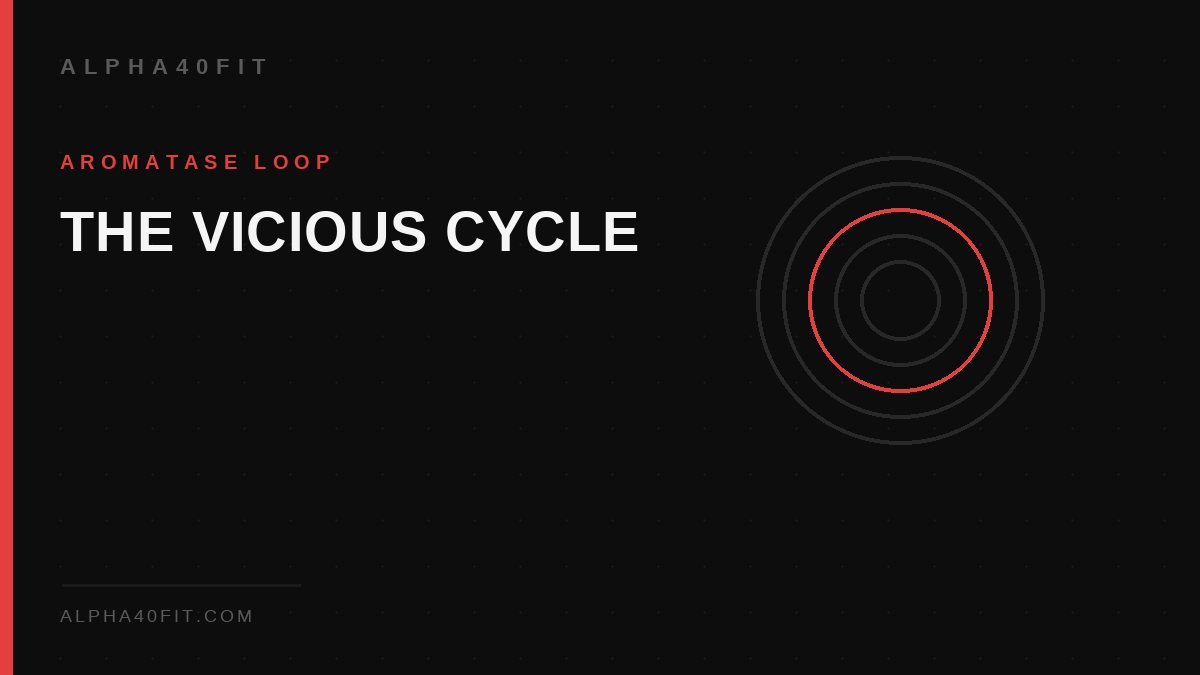
More visceral fat means more aromatase, which means lower testosterone, which means even more visceral fat. The loop feeds itself:
More belly fat → more aromatase → lower testosterone → more belly fat.
This is why some men over 40 feel like they hit a wall that wasn’t there at 30. It’s not just slower metabolism or “getting older.” It’s a feedback loop that, once it gets going, actively resists the half-measures that used to work. Cutting dessert and walking a bit more doesn’t break a loop with this much momentum.
The flip side — and this is the part to hold onto — is that the same loop runs in reverse once you get it moving the other way.
The Loop Runs Both Ways
The encouraging evidence here is unusually strong.
A meta-analysis of weight-loss studies in men found that losing body weight significantly raised testosterone and lowered estrogen — and the more weight men lost, the bigger the hormonal improvement (PubMed: Corona et al., 2013, Eur J Endocrinol). Diet-driven fat loss reliably moved testosterone upward, with the largest gains in the men who had the most to lose.
That’s the loop reversing. Less fat means less aromatase, which means less testosterone-to-estrogen conversion, which means the brain stops suppressing production, which means more testosterone, which makes losing the next pound of fat easier. The same momentum that worked against you starts working for you.
You don’t have to get to single-digit body fat to trigger this. The research shows meaningful hormonal gains from meaningful — not extreme — fat loss. The first stretch of progress is where the metabolic loop flips, and that’s the hardest part to start and the most rewarding to finish.
How to Break the Cycle
This isn’t a special protocol. It’s the fundamentals, executed with the understanding that you’re breaking a loop, not just “losing weight.”
Target visceral fat specifically — through a real calorie deficit. Visceral fat is actually more responsive to fat loss than the stubborn subcutaneous kind. A sustained, moderate calorie deficit is the lever. You can’t aromatase your way thin; you have to remove the fat that’s producing the enzyme.
Cut the sugar and ultra-processed carbohydrate first. Chronic blood-sugar spikes and the insulin resistance they create are tightly bound up with visceral fat. This is usually the highest-yield dietary change.
Lift weights. Building muscle improves insulin sensitivity and shifts your body toward storing less visceral fat. It also defends against the muscle loss that otherwise accelerates the whole cycle.
Protect your sleep. Poor sleep raises cortisol and independently lowers testosterone and drives visceral fat storage. You can’t out-train a chronic sleep deficit.
Keep alcohol occasional. Regular drinking adds empty calories, disrupts sleep, and suppresses testosterone directly — three inputs into the same loop.
Notice that none of these are exotic. The point isn’t a secret tactic. The point is why they work: every one of them attacks the belly-fat-to-low-testosterone loop at a different node, and together they flip its direction.
Where a supplement fits in (and where it doesn’t): Nothing in a capsule out-runs the fat that’s producing the aromatase — fat loss is the move. That said, some men’s formulas try to attack the conversion directly. EndoPeak, for example, includes chrysin, a natural aromatase inhibitor — though, as I explain in my EndoPeak review, oral absorption is chrysin’s real weak point, so treat it as a minor support, not the solution. If you want to see how the rest of its formula stacks up, you can check the current price here. (Affiliate link — I may earn a commission at no cost to you.)
Frequently Asked Questions
How does belly fat lower testosterone?
Fat tissue produces aromatase, the enzyme that converts testosterone into estrogen — and the rising estrogen also signals your brain to dial down the LH that tells your testes to make testosterone (PubMed: Genchi et al., 2022, Int J Mol Sci). So belly fat hits you twice: it converts the testosterone you have and suppresses new production.
Can losing weight actually raise testosterone?
Yes. A meta-analysis of weight-loss studies found that losing body fat significantly raised testosterone and lowered estrogen, with the biggest gains in men who lost the most (PubMed: Corona et al., 2013, Eur J Endocrinol). The same loop that worked against you reverses.
Why is it called a vicious cycle?
Low testosterone makes your body store more visceral fat, which produces more aromatase, which lowers testosterone further. More belly fat → more aromatase → lower testosterone → more belly fat. It feeds itself until you break it.
Do I need to get extremely lean?
No. The research shows meaningful hormonal gains from meaningful — not extreme — fat loss. The first stretch of progress, where the metabolic loop flips, is the part that matters most.
What’s the highest-yield change to break the cycle?
A sustained, moderate calorie deficit that strips visceral fat — starting with cutting sugar and ultra-processed carbs, plus lifting weights to protect muscle and insulin sensitivity. You can’t out-supplement the fat producing the enzyme.
The Bottom Line
Your belly fat isn’t just a cosmetic issue or a number on a scale. It’s metabolically active tissue that converts your testosterone into estrogen and tells your brain to stop making more — a loop that quietly entrenches itself through your 40s and 50s.
That sounds grim until you remember the loop is symmetrical. Strip the visceral fat and every mechanism reverses: less conversion, less suppression, more testosterone, easier fat loss. The men who understand this stop treating fat loss as vanity and start treating it as the single highest-leverage move for their hormones.
Break the loop at the fat, and the testosterone follows.
The Formula I Point Readers To · Affiliate Link
Rather buy one capsule than four separate bottles?
EndoPeak
Everything this article points to — Tongkat Ali to lower SHBG, plus magnesium, saw palmetto and epimedium — assembled in a single formula. It's the male-performance stack I'm comfortable putting my name next to, because the ingredient choices are defensible (I broke them all down in my review).
🛡60-day money-back guarantee. A fair 90-day trial risks nothing.
Free PDF
Get the free Testosterone After 40 Field Guide
The short list of what actually moves your testosterone — with the studies behind it. No spam. Unsubscribe anytime.